
Hygiene and asepsis in the clinic.
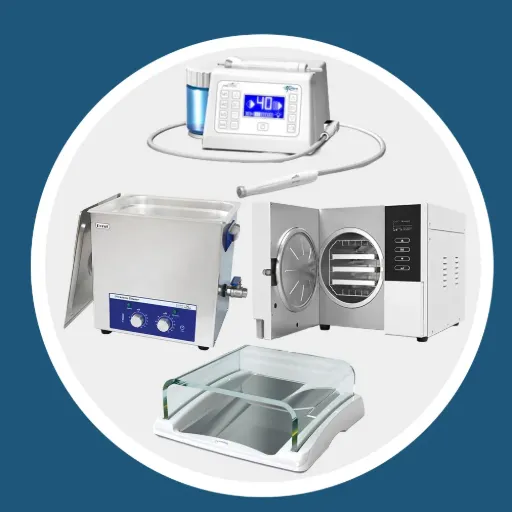
Autoclaves, ultrasonic cleaners, sterilization pouches and disinfectants: all of instrument reprocessing, in one place.

Specialties

In short
Every instrument, every patient.
Instrument reprocessing always follows the same order: clean, package, sterilize, record. Surfaces are disinfected between every patient.
- Clean before you sterilize: a dirty instrument does not become sterile.
- A Class B autoclave for packaged and hollow instruments.
- Tests and a log to prove each cycle worked.
- A surface disinfection routine between patients.
Knowledge and advice
All about hygiene and asepsis
From classifying instruments to keeping the log, explained simply.
Classifying instruments
The level of reprocessing depends on how an instrument is used. Instruments are classified by the risk they pose to the patient.
In foot care, most instruments that touch the skin or nails can break the skin. So they are sterilized between every patient.
- Critical: they penetrate the skin, like blades and nippers. Sterilization.
- Semi-critical: they touch skin that is not intact. Sterilization recommended.
- Non-critical: they touch intact skin, like the chair. Cleaning and disinfection.
The reprocessing cycle
Every instrument follows the same route, from the chair to storage. Skipping a step compromises the whole cycle.
- Pre-clean at the chair, without letting residue dry
- Clean by hand or in the ultrasonic cleaner, rinse and dry
- Inspect, then package in a pouch with an indicator
- Sterilize with the right cycle, then store dry
- Record the cycle, the date and the lot in your log
Autoclave classes
Autoclaves differ in what they can sterilize. Class B, with its fractionated pre-vacuum, handles every type of load, including packaged, hollow or porous instruments.
Class N only suits solid, unpackaged instruments. Class S handles the loads specified by the manufacturer. For packaged instruments, choose Class B.
Proving it worked
A successful cycle has to be proven. Indicators and the log show that every load was properly sterilized.
- A chemical indicator in every pouch
- A steam penetration test for Class B autoclaves
- Biological indicators, as often as your order’s standards require
- A log kept up to date, cycle after cycle
Between patients
Surfaces touched during care are disinfected every time. Respect the contact time shown on the disinfectant: that is what makes it effective.
- Chair, footrest, trolley and lamp
- Fresh gloves for every patient
- Hand hygiene before and after every treatment
- A clean drape for every new patient
Our range
Everything for hygiene and asepsis
The materials, sorted by each step of reprocessing.
-
Clean
To remove residue before sterilization, and look after your instruments.
-
Package and sterilize
Autoclaves, accessories and pouches with indicators.
-
Disinfect surfaces
For the treatment room, between every patient.
-
Protect yourself
Protective equipment for you and your team.
-
Prepare the patient’s skin
To clean the skin before treatment.
Frequently asked questions
Which autoclave class do I need?
For packaged or hollow instruments, Class B.
Do you service autoclaves?
Yes. Our workshop handles preventive maintenance and repairs on the autoclaves we sell.
How long does an instrument stay sterile?
As long as the pouch stays intact, dry and properly stored.
Do I need an ultrasonic cleaner?
It is not mandatory, but it cleans joints and hard-to-reach areas better, and it reduces handling.
Can I reuse a scalpel blade?
No. Blades are single-use: discard them in a sharps container after every patient.

Unsure about your protocol?
Our team helps you choose the autoclave and consumables that suit your clinic.